
Written By: Brad Campbell | December 23, 2025
Architects navigating modern building design are used to the expanding expectations placed on exterior glazing systems.
Whether the goal is maximizing natural light, reducing energy demands, strengthening security, or creating a signature façade with crisp visual lines, the choice between storefront and curtain wall systems is one of the most important early decisions in any commercial building’s design.
When deciding between storefront vs curtain wall glazing, it’s crucial to ensure you understand the subtle differences in structural behavior, system composition, anchoring methods, and available spans, all of which can significantly influence complexity, cost, and long-term performance.
Additionally, with rising interest in protective security glazing, it’s also important to factor the security capabilities of each system into your decision, especially for ground-floor retail and multi-story commercial applications where risk profiles differ significantly.
Storefront and curtain wall systems share many surface-level similarities. Both introduce abundant daylight, maximize visibility, and modernize exteriors with clean, linear aesthetics. Both allow for a wide variety of glazing types, including high-performance insulated units, tints, coatings, and security glass.
The aluminum framing in either system can also be finished in a range of anodized or painted options to support brand identity or architectural cohesion.
But beyond these shared characteristics, the technical distinctions matter greatly when evaluating load requirements, spans, water/thermal management, and integration with the surrounding structure.

Storefront framing is typically grounded directly into the building structure, meaning vertical loads (including wind loads) are transferred downward to the sill and then into the surrounding framing or slab. The system is non-load-bearing for the building itself and is designed for shorter vertical spans, typically a single story.
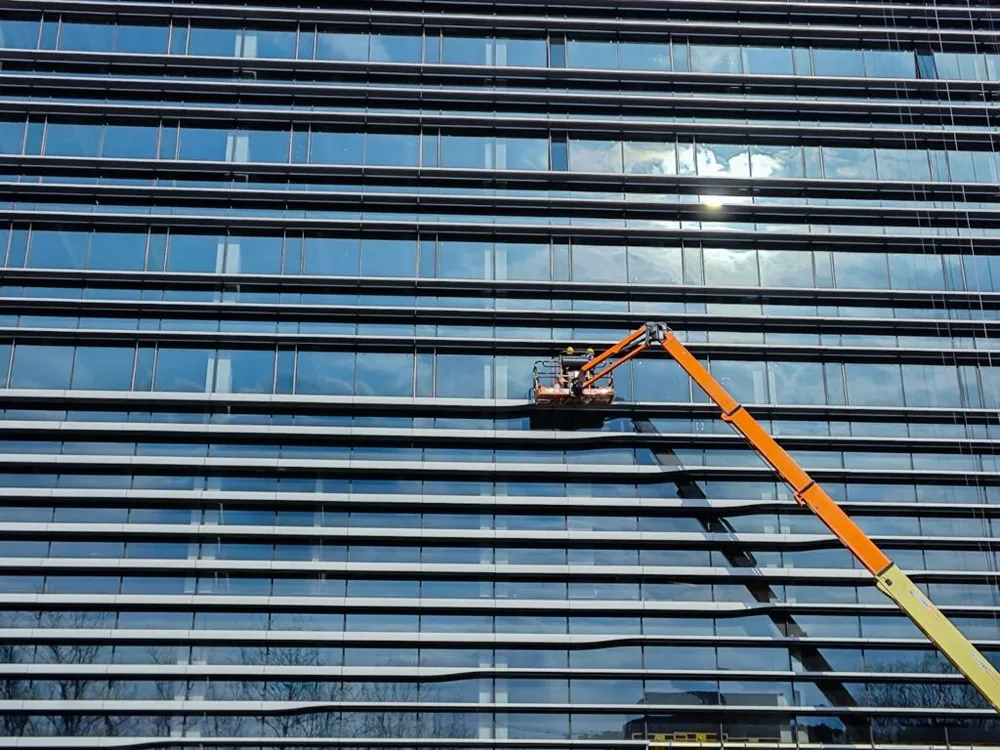
Curtain walls are independent cladding systems hung from floor slabs, transferring loads back to the primary structural frame. This allows for multi-story spans and greater flexibility in vertical elevation changes.
Curtain walls accommodate larger glass panels, deeper mullions, and more robust anchoring systems, enabling performance under significantly higher wind loads and thermal movement.

Storefront mullions are shallower, commonly between 1 3/4” and 4 1/2”, because they don’t need to support multi-story loads, whereas curtain wall mullions often range from 6” to 10” or more, depending on span and project requirements. The increased depth accommodates:
Storefront systems are anchored at the head and sill with relatively simple clips. Curtain walls use embedded anchors, brackets, and sometimes custom-engineered connections at each floor slab.
Installation sequencing also differs: storefronts install more like a window system, while curtain walls install panel-by-panel or grid-first with unitized or stick-built methods.
Storefronts rely on face-sealed or water-deflected weep systems and aren’t designed for high-pressure water exposure. Their performance rating is suitable for low-rise applications but limited in demanding climates.
Curtain walls use pressure-equalized rain screens, incorporating internal drainage paths, pressure chambers, and thermal breaks engineered for superior air and water infiltration control, an essential feature for high-rise structures.
Your choice depends heavily on building height, budget, desired spans, and the role that glazing plays in the project’s visual identity.
Storefront window and door systems excel in ground-floor, pedestrian-oriented environments, particularly where the building’s envelope needs to function like a display or engagement point.
They are ideal for:
Storefronts are naturally suited to shorter spans and moderate performance requirements, and because they are less complex to engineer and install, they remain the more economical option.
Curtain wall systems shine in projects where the glazing façade is part of a bold architectural expression or where building performance demands surpass what storefront systems can handle. They work best for:
Curtain walls are more costly and complex, but they offer unmatched flexibility in height, detailing, and energy performance strategies.
Security glazing, whether for forced-entry resistance, storm impact mitigation, ballistic protection, or riot resistance, has become a critical factor in commercial architectural design. Fortunately, both storefront windows and curtain walls can be engineered to meet demanding security criteria.
Storefront windows are typically very straightforward to protect with fully integrated security glazing. They’re also highly retrofittable, making it easy to upgrade them with protective glazing shields after initial construction.
Because storefront spans are smaller and glass sizes are more standard, upgrading the system (either during or after construction) is often:
This makes storefront glazing systems an excellent candidate for retail properties or other buildings that may require hardened protection for ground-floor entryway doors and windows.
Curtain walls can absolutely achieve high levels of security, and many architects now integrate forced-entry-resistant or even ballistic-rated glazing into their curtain wall designs. However, there are unique challenges:
Despite these complexities, curtain walls can be made highly secure, especially when security glazing is planned for early in the architectural design process.
Naturally, storefront systems are generally cheaper and faster to secure, simply because there is less glass involved and fewer structural constraints.
Curtain wall security upgrades can be more involved, but with the right materials and engineering, both systems can achieve exceptional performance levels, including meeting sustainability targets, when paired with the right glazing materials.
Both storefront and curtain wall systems offer architects powerful tools for shaping the aesthetics and performance of modern commercial buildings.
Storefronts excel in ground-floor retail and low-rise applications where cost efficiency and visibility are key.
Curtain walls, on the other hand, are ideal for multi-story structures, architectural statement façades, and environments requiring advanced structural and thermal performance.
Both system types can be fully upgraded to meet increasing demand for high-security glazing, storefronts more easily and cost-effectively, and curtain walls with more advanced engineering support.
The best choice ultimately depends on span requirements, design intent, budget, and the building’s unique performance needs.
Not necessarily. Curtain walls generally offer more advanced thermal-break technology, but high-performance storefront systems can achieve strong energy ratings for low-rise applications. The difference becomes more pronounced as building height and environmental exposure increase.
Storefront systems are designed primarily for single-story spans. They can be used on multiple levels, but not as continuous multi-floor façades. Each level must be structurally broken and supported.
It can be, depending on glass size and mullion depth. Larger curtain wall lites may require heavier or custom-sized security glazing, whereas storefronts typically use standard dimensions that retrofit easily.
Often yes, but not inherently. Curtain walls are more commonly paired with high-performance insulated or laminated units that reduce noise transfer. However, the glazing makeup, not the system type, ultimately determines acoustic performance.
In many cases, yes. Both can use similar finishes, glass types, and mullion profiles. The biggest aesthetic difference is scale: curtain walls support larger spans and taller façades, creating a more seamless and continuous all-glass appearance.
Want to discuss best-fit security glazing for your storefront or curtain wall design? Contact Riot Glass for specification support or a free consultation.

HOW CAN WE HELP YOU?