
Written By: Brad Campbell | February 16, 2023
In the security glazing industry, bullet-resistant products are rated using a scale developed by Underwriters Laboratories (UL), an independent, non-profit safety science organization. That scale is UL 752, and it's the standard nearly every bullet-resistant window, door, and wall panel in the United States is tested against.
Riot Glass LLC's ballistic-grade security glazing is rated according to the UL 752 scale, up to Level 7. This page provides all the guidance needed to understand the standard: what it measures, how the testing works, what each of the 10 UL 752 levels means, and how to figure out which one is right for your property.
UL 752 is the Underwriters Laboratories standard for bullet-resistant materials and systems. It defines how building components, including windows, doors, barriers, and wall assemblies, are tested for their ability to stop or delay bullet penetration.
The UL 752 standard doesn't just measure whether a material stops a bullet. It measures the material's performance against a specific, defined threat: a particular firearm, a particular caliber and bullet weight, a set velocity range, a set number of shots, and a set distance from the muzzle to the target. That's why the UL 752 chart looks the way it does. Each level isn't a vague "stronger" or "weaker" rating. It's a documented test result against a named round and firearm.
UL itself has been developing safety standards since 1894. The organization is headquartered in Northbrook, Illinois, and now maintains offices in dozens of countries, certifying everything from electrical equipment to security glazing. For architectural bullet resistance specifically, UL 752 is the benchmark most manufacturers, architects, and security consultants in the U.S. specify against.

Every UL 752 level is defined by five variables:
A sample fails the test if a round fully penetrates the material. To earn a rating, a glazing assembly has to stop every shot in the test sequence, not just the first one. That's an important distinction for anyone comparing UL 752 ballistic glass to other rated products: a UL 752 Level 6 pane isn't stopping one lucky shot; it's stopping five rounds fired at handgun velocity in a tight group.
Here is the complete UL 752 chart covering all 10 levels plus the standard's shotgun testing.
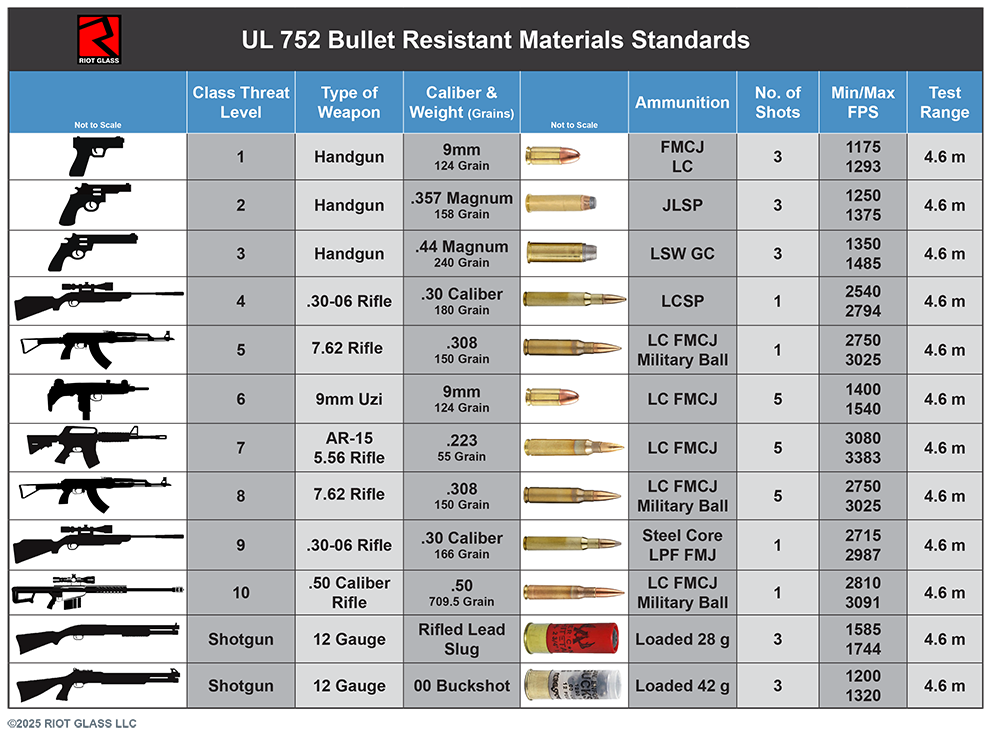
UL 752 Level 1 is the entry point of the UL 752 scale and the most commonly specified rating in commercial settings. It requires the glazing to stop three shots from a 124-grain, 9mm full metal jacket (FMJ) round at 1175 to 1293 fps. The 9mm is the most widely owned handgun caliber in the U.S., which makes Level 1 the baseline for retail counters, pharmacies, gas stations, and transaction windows.
UL 752 Level 2 steps up to a higher-energy handgun round, testing three shots of 158-grain .357 Magnum jacketed lead soft point ammunition at 1250 to 1375 fps. This rating is common in financial settings such as banks, credit unions, and check-cashing businesses, where the perceived handgun threat runs higher than general retail.
UL 752 Level 3 is the top of the handgun tier on the UL 752 chart. It tests three shots of 240-grain .44 Magnum lead semi-wadcutter, gas-checked, at 1350 to 1485 fps. Facilities that specify UL 752 Level 3 glass tend to be higher-risk environments where a large-caliber handgun is a realistic threat: courthouses, detention facility visitor areas, police stations, and high-security cashier stations.
UL 752 Level 4 marks the transition from handgun to rifle protection. It requires the glazing to stop a single shot from a 180-grain .30 caliber rifle round (soft point) at 2540 to 2794 fps. Because a rifle round carries far more energy than any handgun round on the chart, this is a meaningful jump in required protection, even though it's tested with just one shot instead of three.
UL 752 Level 5 tests a single shot from a 150-grain, 7.62mm full metal jacket military ball round (.308 caliber) at 2750 to 3025 fps. This is a higher-energy rifle threat than Level 4 and represents the kind of round fired by common hunting and battle rifles.
UL 752 Level 6 returns to the 9mm caliber used in Level 1, but the test changes in two ways: five shots instead of three, fired at a higher velocity range of 1400 to 1540 fps, consistent with a submachine gun rather than a standard handgun. Products with this rating are typically specified for high-security government and specialized law enforcement applications where sustained handgun-caliber fire is a concern.
UL 752 Level 7 requires the glazing to stop five shots of 55-grain, 5.56mm full metal jacket ammunition, the round fired by an AR-15 and similar platforms, at velocities between 3080 and 3383 fps. This is currently the highest level Riot Glass offers, and it reflects the caliber most commonly associated with active threat and mass-casualty events at U.S. commercial and institutional facilities.
UL 752 Level 8 uses the same ammunition as Level 5, a 150-grain, 7.62mm full metal jacket military ball round at 2750 to 3025 fps, but requires the glazing to stop five shots instead of one. This level is reserved for very high-risk government and military applications where sustained rifle fire from a battle-caliber weapon is part of the threat profile.
UL 752 Level 9 introduces an armor-piercing round: a 166-grain, steel-core, .30 caliber full metal jacket bullet fired at 2715 to 2987 fps. The steel core is what separates this level from Level 4, which uses a similar caliber but a standard lead-core soft point round. Level 9-rated materials are built to defeat rounds specifically designed to penetrate hardened barriers, placing this level well into specialty military and high-security government territory.
UL 752 Level 10 is the highest rating on the UL 752 scale. It requires the glazing to stop a single shot from a .50 caliber rifle round, 709.5 grains, full metal jacket military ball, at 2810 to 3091 fps. This is a specialized, military-grade rating, and UL 752 Level 10 ballistic glass is built for the most extreme threat environments rather than typical commercial or institutional use.
Alongside the 10 numbered levels, UL 752 also defines two separate shotgun tests. To pass, glazing must stop three shots of 12-gauge rifled lead slug (28-gram load) at 1585 to 1744 fps, or three shots of 12-gauge 00 buckshot (42-gram load, 12 pellets per shot) at 1200 to 1320 fps. Because shotgun ammunition behaves differently than a single rifle or handgun round, this test is run and reported separately from the Level 1-10 scale.
No security product is 100% bulletproof, regardless of what a spec sheet or a salesperson implies. The accurate term is bullet resistant: a product rated at a given UL 752 level can stop a specific number of shots from a specific round fired by a specific weapon, at a specific velocity. Go outside those parameters, whether that's more rounds, a different caliber, or a more powerful weapon, and penetration becomes possible.
A UL 752 Level 1-rated pane will stop three rounds from a 9mm handgun. It will not stop a single round from a .50 caliber rifle. That's the nature of a graduated standard: each level is built and tested for a defined threat, not for every threat.
Since no product is fully bulletproof under all possible conditions, the true value of UL 752-rated glazing comes down to two words: access denial.
During an active threat event at a school, office, or government building, an attacker's fastest way into a building is usually through a vulnerable window or door. Ballistic-grade glazing reduces that vulnerability. Depending on the UL 752 level installed, it can absorb several rounds from the handguns and rifles most commonly used in these incidents, buying the people on the other side critical seconds to run, hide, or barricade.
Even after a round penetrates the outer layer of security glazing, an attacker still can't reach through it to unlock a door or climb through an opening. There’s a huge difference between "penetrated" and "breached," which means lives are protected while law enforcement responds.
Benefits of UL 752-rated glazing in an active threat scenario include:
The right UL 752 level depends on your building's actual threat profile, not just its industry and location. A general retail storefront and a bank cashier window face different realistic threats, even though both might sit in the same city block.
As a general guide:
The most reliable way to land on the right level is a professional threat assessment. A security consultant reviews your building's existing measures, identifies weak points such as unprotected glazing, and recommends a UL 752 level based on both the perceived and documented risk to your property.
Riot Glass RG-Series glass-clad polycarbonate and AP-Series polycarbonate security glazing solutions are available with UL 752 ratings up to Level 7, meaning our products are tested to stop up to five shots from a 5.56mm rifle (AR-15) at velocities up to 3383 fps. That covers the full range of common commercial ballistic security requirements, from everyday retail security up through active-threat-grade rifle protection for schools and government facilities.
<iframe width="560" height="315" src="https://www.youtube.com/embed/pMWE7df7pTc?si=9fU2MYVuxX6UkLen" title="YouTube video player" frameborder="0" allow="accelerometer; autoplay; clipboard-write; encrypted-media; gyroscope; picture-in-picture; web-share" referrerpolicy="strict-origin-when-cross-origin" allowfullscreen></iframe>
If ballistic protection isn't necessary for your facility but forced entry and burglary are still concerns, Riot Glass also offers containment-grade, non-ballistic security glazing as a lighter-duty option.
It's the Underwriters Laboratories standard number for bullet-resisting equipment. UL 752 is the name of the standard itself.
Ten numbered levels, plus separate shotgun testing that isn't assigned a level number.
Three shots of .44 Magnum, 240-grain lead semi-wadcutter ammunition at 1350 to 1485 fps. It's the highest handgun-class rating on the UL 752 chart.
One shot of .50 caliber rifle ammunition, 709.5 grains, at 2810 to 3091 fps. It's the highest rating on the UL 752 scale.
Up to UL 752 Level 7, which covers 5.56mm rifle threats fired from an AR-15 or similar firearm.
Not necessarily. The right ballistic resistance level depends on your facility's actual threat profile. Over-specifying adds cost and weight without added benefit if the threat level doesn't warrant it, which is why getting a professional threat assessment is better than defaulting to the highest number you can afford.
Contact Riot Glass to talk through which UL 752 level fits your property, or to schedule a threat assessment.

HOW CAN WE HELP YOU?